
What are the implications for cognitive development and health in a digital age?
Introduction
The rapid rise of digital technology has transformed how people learn, communicate and process information, as well as various aspects of everyday life, from banking to shopping to entertainment. This includes the use of digital TVs, computers, laptops, video game consoles, tablets, smartphones and smart watches. As screen use and digital engagement increase, researchers have begun to examine their potential cognitive impacts, including effects on attention, memory, executive function, and brain development. This article explores these implications and both the potential benefits and risks. It considers how factors such as age, type of use, and context shape cognitive outcomes in a digital age.
Children
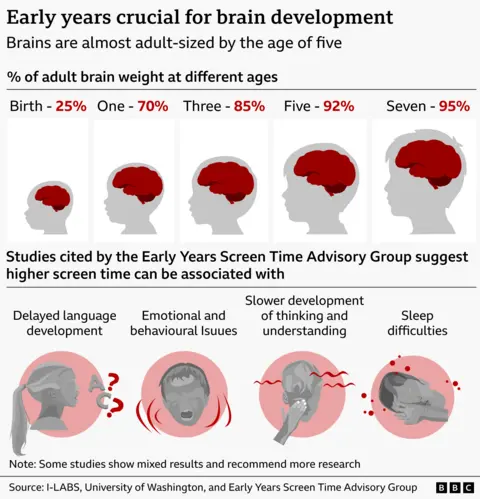
The early years are particularly important for cognitive development and so potentially particularly open to being influenced by growing up in a digital age.
Research suggests that differences in neural connectivity can be observed in children with attention-related disorders. Early functional changes in brain networks may be precursors to visible changes in white matter structure later on, which is associated with processing information and solving problems. Some studies indicate that children who spend more time in rich, three-dimensional, real-world environments tend to show stronger connectivity between the frontal lobes and other brain regions.1
In contrast, higher levels of prolonged digital content consumption have been associated with comparatively different patterns of connectivity, existing independently of an ADHD diagnosis or cognitive condition. MRI scans have reported associations between high levels of early digital media use and variations in gray matter development in children as young as 3 to 5 years old.2 These differences are observed in regions linked to language, reading, empathy, and other higher-order cognitive functions. Overall, researchers suggest that continued imbalance between real-world experiences and screen-based activities may influence how these developmental patterns evolve over time, though long-term outcomes are still being studied.
Newly released government guidelines followed a report by early years charity Kindred Squared. These advise that screen use for under 5s should be limited to a maximum of 1 hour per day for 2 to 5 year olds, and carefully managed to support healthy development.3 4 With 90% of children’s cognitive development happening before the age of five, parents are being encouraged to make safe screen swaps like reading bedtime stories together, or playing simple games at mealtimes. Evidence suggests that co-viewing screens with an engaged adult supports better cognitive development than children using screens alone. 5 It also indicates that slower-paced content is more beneficial for learning than fast-paced, social media-style videos. However, screen-time limits are not always appropriate for assistive technologies, particularly when used to support children with special educational needs and disabilities.
Adolescents
A 2023 US study of nearly 12,000 children aged 9-12 found no evidence that screen time harms brain development or wellbeing. Using data from the long-term Adolescent Brain Cognitive Development (ABCD) study, researchers compared children’s self-reported screen use (including TV, videos, gaming, and social media) with brain scans, cognitive performance, and mental health measures over two years. When analysing the screen time use alongside the ABCD data, patterns of functional brain connectivity were related to patterns of screen engagement, but there was no meaningful association between screen time use and measures of cognitive and mental well-being.6
The researchers noted that if screen time had a meaningful effect on brain development or well-being, consistent differences would be expected across cognitive and well-being measures. However, the large, representative dataset did not show such patterns. They also highlighted the strength of the methodology, noting that the analysis plan was peer-reviewed before the data were accessed.7
A large longitudinal study published in 2024, also used data from the ABCD study. It examined whether digital media use such as via video games, social media, and television is associated with changes in brain structure during late childhood and early adolescence.8 Over approximately four years, participants aged roughly 9.9 years old when entering the study completed repeated assessments of digital media use alongside MRI scans. The scans measured development of the cortical surface area, striatum and cerebellum, regions associated with higher-order cognitive and behavioural functioning. Greater engagement with video games was associated with increases in cortical surface area and cerebellum volume over time. In contrast to the earlier study, high social media use was associated with a minor decrease in cerebellum volume at the final time point. Television viewing showed little consistent relationship with brain structure and there was no significant interaction between playing video games or social media use and the other brain regions studied.
In a different study, 824 students, aged 11 to 17, representing diverse socioeconomic and educational backgrounds around the world completed structured tasks designed to assess attention, creativity, and frustration, when either using a smartphone or a computer.9 The computer group consistently outperformed across all measures. The authors stated that
the study’s findings provide compelling evidence that the mode of digital interaction significantly impacts children's cognitive and creative development rather than how long they do so. This aligns with theories which suggest that the use of a mouse and keyboard supports more deliberate mental processing compared to rapid touch mediums with limited design flexibility such as phones (Resnick, 2017).10
Adults
In a 2024 study conducted in the UAE, 139 healthy young adults aged between 18-35 were instructed to estimate the total time spent in hours and minutes using electronic devices. This included, television, streaming devices or video game consoles connected to TV, laptop/computer, smartphone or tablet.11 They were later given tasks measuring cognitive ability such as by adding numbers continually to a sequence, matching symbols to numbers and the Montreal Cognitive Assessment 30 point screening tool which assesses cognitive domains such as memory, language and orientation.

Higher night-time screen use was associated with poorer working memory, sustained attention and mental processing speed. There was no significant association between cognitive performance and daytime screen use. The researchers suggested that night time screen use may impair cognition via sleep disruption or fatigue, and reduce cognitive reserve potentially increasing vulnerability to later cognitive decline. Because the study is cross-sectional, it only shows a correlation and cannot establish whether night time screen time causes cognitive decline or is simply associated with it. Furthermore, daytime and nighttime were not objectively defined which may reduce the reliability of the findings.
A 2022 literature review examining the effects of increased screen time across cognitive functioning appears to support these findings. They explain that prolonged screen time is strongly linked to sleep disruption, as exposure to blue light interferes with melatonin production and circadian rhythms, leading to poor sleep quality and fatigue.12 The review also suggests that sedentary screen-based behaviours are linked to increases in cardiovascular problems. Playing video games has been associated with a decline in HDL cholesterol in obese teenagers (Lam 2014; Palaus et al. 2017).13.14 High levels of HDL are associated with lower risk of heart disease and stroke, which can increase the risk of cognitive difficulties, including impairments in memory, attention, and executive functioning. This suggests that some cognitive effects of excessive screen use may be explained in part by lifestyle factors rather than screen time directly.
The review goes on to mention research which has explored the effects of screen multitasking, where constant shifting of attention between digital devices replaces engagement in real-world activities. Findings show that college students who frequently multitask have reduced grey matter in the anterior cingulate cortex, a region involved in cognitive control and emotional regulation. These individuals tend to perform worse in tasks involving attention, working memory, and task-switching. Further studies also link decreased grey matter to poorer conflict detection, higher levels of impulsivity and neuroticism, reduced goal-directed behaviour, and a greater tendency toward sensation-driven actions.
UK Biobank data from more than 407 thousand participants aged between 37 and 73 years old in the early 2000s found upon follow up several years later that those who restricted daily TV viewing time to 3 hours was found to be the most beneficial. In contrast, those who watched television for five hours or more per day had an increased risk of developing brain-related disease like dementia, stroke, or Parkinson’s.15 The researchers also observed that higher levels of TV watching were linked to lower levels of grey matter volume, responsible for core cognitive processes such as thinking, information processing and decision making, and hippocampal volume, responsible for memory formation and learning.
A 2025 study investigating the effects of digitisation on cognitive function examined data from 150 participants aged 15 to 40 through standardized cognitive assessments, self-reported questionnaires measuring screen time, sleep quality, physical activity, and digital content type.16 The findings indicate a significant negative association between prolonged screen time and cognitive performance, with reduced attention span, weaker concentration, and less effective problem-solving in some contexts. Furthermore, passive forms of digital consumption were more strongly associated with reduced cognitive performance than active or educational use. These results suggest that managing screen time may be important for maintaining cognitive health and the authors highlight the need for strategies promoting healthier patterns of digital engagement.
Older Adults
The digital dementia hypothesis coined by German neuroscientist Manfred Spitzer in 2012 17 suggested that increased use of digital devices has resulted in reduced cognitive ability due to overreliance on technology. A meta-analysis using data from more than 411,000 adults in 57 studies was published in Nature of Human Behaviour 2025. However, it found no supporting evidence for the hypothesis.18,19 Cognitive decline was measured by lower performance on cognitive tests or a diagnosis of dementia. It was found that the use of computers, smartphones and the internet among people over 50 might actually be associated with lower rates of cognitive decline.
Digital use among older adults may offer cognitive, social, and informational benefits. Cognitive training delivered via computer programs, apps, wearables, and web-based platforms can target memory, attention, and executive function, with evidence suggesting improvements in overall cognitive performance and daily functioning (Ziegler et al., 2022).20
Similarly, engaging with brain-training apps and interactive games has been linked to gains in memory, attention, and problem-solving (Anguera et al., 2013) 21, while social media use has been associated with reduced loneliness and increased social support (Cotten et al., 2014).22 Researchers note that technology use can support cognition, and that healthier cognition can lead to more use in older age, suggesting that there are potential cognitive benefits, though causality remains unclear.
A recent scoping review evaluated findings on cognitively engaging activities used by adults in mid and later life such as email use, word processing, web browsing, and cognitive games. It found that these forms of active digital engagement are often associated with more favourable outcomes in cognitive domains including memory, attention, and executive function 23. These patterns are consistent with the cognitive stimulation hypothesis, which proposes that sustained mental engagement through digital activity may help preserve cognitive functioning in later life, although effects vary across studies and cognitive measures.
At the same time, balancing digital engagement is important; “Digital detoxes” may reduce stress and restore cognitive function (Duke and Montag, 2017) 24, while regular physical activity supports cognition, mood, and sleep (Sibley and Etnier, 2003).25 Digital literacy education and tools that monitor or limit screen time can also help promote healthier technology use (Hobbs, 2010).26
Artificial Intelligence
The advance of generative artificial intelligence (AI) has shown great potential to enhance productivity in many cognitive tasks, where the automation of menial tasks potentially releases time to extend cognitive ability. However, a concern is that AI use may erode human cognition due to overreliance.27 For example, widespread use of AI carries the risk of overall cognitive atrophy and loss of brain plasticity. Researchers at the Massachusetts Institute of Technology (MIT) conducted a four-month study involving 54 participants who were asked to write essays without assistance, with access to the internet via a search engine or with ChatGPT.28 Neural activity was monitored by EEG and it was found that using the internet, and ChatGPT in particular, significantly reduced cognitive engagement and “relevant cognitive load”, the intellectual effort required to transform information into knowledge. Participants assisted by ChatGPT wrote 60% faster, but their relevant cognitive load fell by 32%. Moreover, brain connectivity was almost halved and 83% of AI users were unable to remember a passage they had just written. Whilst this research is potentially relevant it is important to note that the paper is in pre-print and currently under review.
A review published in Frontiers in Cognition (2023) examined evidence on how screen time and digital media use are associated with cognitive processes such as attention, memory, executive function, and learning.29 It found that higher levels of digital media use, particularly when involving multitasking or rapidly switching between tasks, are associated with reduced sustained attention, weaker inhibitory control, and increased distractibility. It also reported evidence that heavy screen users may show reduced depth of learning and greater reliance on “cognitive offloading”, thus relying on AI to do thinking tasks for them and consequently reducing mental effort.
A 2025 study conducted in Switzerland investigated the relationship between AI tool usage and critical thinking skills using a mixed-method approach of surveys and in-depth interviews with 666 participants across diverse age groups and educational backgrounds.30 The findings revealed a significant negative correlation between frequent AI usage and critical thinking abilities, mediated by increased cognitive offloading. Younger participants exhibited higher dependence on AI tools and lower critical thinking scores compared to older participants. In addition, higher educational attainment was associated with better critical thinking skills, including greater scepticism of AI regardless of usage. This contrast highlights how education level mediates the ability to critically evaluate AI-provided information. Conversely, some participants also highlighted the positive aspects of AI, such as improved efficiency and the ability to handle routine tasks quickly, freeing up mental resources for more complex cognitive activities.
The study highlights important implications for education; while AI tools can support learning, overuse may hinder the development of critical thinking, and thus, teaching should include active learning and critical evaluation of AI-generated content, with the researchers calling for balanced use and further research into its long-term cognitive effects.
Conclusion
Overall, the evidence suggests that the cognitive impacts of digital technology are complex and cannot be explained by screen time alone. While some studies report changes in brain structure and connectivity associated with digital media use, these do not consistently translate into measurable differences in cognitive performance or wellbeing.
The findings also suggest that age may play an important role, with potential risks appearing greatest during the formative period of early childhood, more mixed effects during adolescence, and possible cognitive benefits emerging in older adulthood. This developmental pattern is supported by evidence showing early neurodevelopmental sensitivity to environmental stimulation in childhood MRI studies, largely null or mixed cognitive findings in adolescent longitudinal datasets such as ABCD, and potential protective associations between digital engagement and cognitive decline in older adult meta-analyses.
This may help to explain why findings across studies often appear contradictory, as the cognitive effects of digital technology may vary according to age and stage of brain development. In addition, mediating factors, such as the quality and purpose of digital engagement, educational background, passivity of and timing of use, appear to influence outcomes. This highlights that HOW digital technology is used may be more important than how much it is used.
Policy suggestions include:
- Implementing clear, evidence-based guidelines on screen use across different age groups
- Promoting public health campaigns that raise awareness of healthy digital habits
- Supporting early years education initiatives that encourage balanced development through both digital and real-world activities.
- Investing in digital literacy programmes to equip individuals with the skills to critically evaluate online content.
- Further funding for long-term research into the cognitive effects of digital technology (given the sometimes conflicting findings)
Sophie Izzard MSc – Research Associate
References:
- Bos, D. J., Oranje, B., Achterberg, M., Vlaskamp, C., Ambrosino, S., de Reus, M. A., van den Heuvel, M. P., Rombouts, S. A. R. B., & Durston, S. (2017). Structural and functional connectivity in children and adolescents with and without attention deficit/hyperactivity disorder. Journal of Child Psychology and Psychiatry, 58(7), 810–818. https://doi.org/10.1111/jcpp.12712
- Hutton, J. S., Dudley, J., DeWitt, T., & Horowitz-Kraus, T. (2022). Associations between digital media use and brain surface structural measures in preschool-aged children. Scientific Reports, 12(1), 19095. https://doi.org/10.1038/s41598-022-20922-0
- Department for Education. (2026, March 26). New screen time guidance for parents of under-5s. GOV.UK. https://www.gov.uk/government/news/new-screen-time-guidance-for-parents-of-under-5s
- Clarke, V. (2026, March 26). Screen time for under-fives should be limited to one hour a day, parents told. BBC News. https://www.bbc.co.uk/news/articles/c1d936n7445o
- Screen use by children aged under five: independent report Early Years Screen Time Advisory Group. (2026). https://assets.publishing.service.gov.uk/media/69c53daf4a06660f085442a7/EYSTAG_report.pdf
- Miller, J. W., Mills, K. L., Matti Vuorre, Orben, A., & Przybylski, A. K. (2023). Impact of Digital Screen Media Activity on Functional Brain Organization in Late Childhood: Evidence from the ABCD Study. Cortex, 169. https://doi.org/10.1016/j.cortex.2023.09.009
- Spinks, S., & Pacey, R. (2017). OII | No evidence screen time is negative for children’s cognitive development and well-being: Oxford Study. Ox.ac.uk. https://www.oii.ox.ac.uk/no-evidence-screen-time-is-negative-for-childrens-cognitive-development-and-well-being-oxford-study/
- Nivins, S., Sauce, B., Liebherr, M., Judd, N., & Klingberg, T. (2024). Long-term impact of digital media on brain development in children. Scientific Reports, 14(1), 13030. https://doi.org/10.1038/s41598-024-63566-y
- Eldarov, K. (2025). Screen Matters: Cognitive and Behavioral Divergence Between Smartphone-Native and Computer-Native Youth. ArXiv.org. https://arxiv.org/abs/2508.03705
- Resnick, M. (2017). Lifelong Kindergarten: Cultivating Creativity through Projects, Passion, Peers, and Play. In mit.edu. The MIT Press. https://direct.mit.edu/books/book/3134/Lifelong-KindergartenCultivating-Creativity
- Shalash, R. J., Arumugam, A., Qadah, R. M., & Al-Sharman, A. (2024). Night Screen Time is Associated with Cognitive Function in Healthy Young Adults: A Cross-Sectional Study. Journal of Multidisciplinary Healthcare, 17, 2093–2104. https://doi.org/10.2147/JMDH.S462458
- Nakshine, V. S., Thute, P., Khatib, M. N., & Sarkar, B. (2022). Increased Screen Time as a Cause of Declining Physical, Psychological Health, and Sleep Patterns: A Literary Review. Cureus, 14(10). https://doi.org/10.7759/cureus.30051
- Lam, L. T. (2014). Internet Gaming Addiction, Problematic Use of the Internet, and Sleep Problems: A Systematic Review. Current Psychiatry Reports, 16(4). https://doi.org/10.1007/s11920-014-0444-1
- Palaus, M., Marron, E. M., Viejo-Sobera, R., & Redolar-Ripoll, D. (2017). Neural Basis of Video Gaming: A Systematic Review. Frontiers in Human Neuroscience, 11(248). https://doi.org/10.3389/fnhum.2017.00248
- Xu, C., Cao, Z., Lu, Z., Hou, Y., Wang, Y., & Zhang, X. (2024). Associations Between Recreational Screen Time and Brain Health in Middle-Aged and Older Adults: A Large Prospective Cohort Study. Journal of the American Medical Directors Association, 25(8). https://doi.org/10.1016/j.jamda.2024.03.010
- Hasnidar, Hasnidar & Rosalia, Olyvia. (2025). Effects of Screen Time on Brain Health Studies on The Impact of Digitization on Cognitive Function. 2. 215-224. https://doi.org/10.62872/3t5hkh42.
- Spitzer, M. (2012). Digitale Demenz. Nervenheilkunde, 31(07/08), 493–497. https://doi.org/10.1055/s-0038-1628243
- Benge, J. F., & Scullin, M. K. (2025). A meta-analysis of technology use and cognitive aging. Nature Human Behaviour. https://doi.org/10.1038/s41562-025-02159-9
- Wilson, N.-A. (2025, April 14). New study finds no evidence technology causes “digital dementia” in older people. UNSW Edu Au. https://www.unsw.edu.au/newsroom/news/2025/04/new-study-finds-no-evidence-technology-causes-digital-dementia-older-people
- Ziegler, D. A., Anguera, J. A., Gallen, C. L., Hsu, W.-Y., Wais, P. E., & Gazzaley, A. (2022). Leveraging technology to personalize cognitive enhancement methods in aging. Nature Aging, 2(6), 475–483. https://doi.org/10.1038/s43587-022-00237-5
- Anguera, J. A., Boccanfuso, J., Rintoul, J. L., Al-Hashimi, O., Faraji, F., Janowich, J., Kong, E., Larraburo, Y., Rolle, C., Johnston, E., & Gazzaley, A. (2013). Video game training enhances cognitive control in older adults. Nature, 501(7465), 97–101. https://doi.org/10.1038/nature12486
- Cotten, S. R., Ford, G., Ford, S., & Hale, T. M. (2014). Internet Use and Depression Among Retired Older Adults in the United States: A Longitudinal Analysis. The Journals of Gerontology Series B: Psychological Sciences and Social Sciences, 69(5), 763–771. https://doi.org/10.1093/geronb/gbu018
- Shaleha, R., & Roque, N. (2025). From screens to cognition: A scoping review of the impact of screen time on cognitive function in midlife and older adults. DIGITAL HEALTH, 11. https://doi.org/10.1177/20552076251343989
- Duke, É., & Montag, C. (2017). Smartphone addiction, daily interruptions and self-reported productivity. Addictive Behaviors Reports, 6, 90–95. https://doi.org/10.1016/j.abrep.2017.07.002
- Sibley, B., & Etnier, J. (2003, August). (PDF) The Relationship between Physical Activity and Cognition in Children: A Meta-Analysis. ResearchGate. https://www.researchgate.net/publication/235913924_The_Relationship_between_Physical_Activity_and_Cognition_in_Children_A_Meta-Analysis
- Hobbs, R., & Program, S. (2010). Digital and media literacy: A plan of action. https://files.eric.ed.gov/fulltext/ED523244.pdf
- Chen, Y., Wang, Y., Wüstenberg, T., Kizilcec, R. F., Fan, Y., Li, Y., Lu, B., Yuan, M., Zhang, J., Zhang, Z., Geldsetzer, P., Chen, S., & Bärnighausen, T. (2025). Effects of generative artificial intelligence on cognitive effort and task performance: study protocol for a randomized controlled experiment among college students. Trials, 26(1). https://doi.org/10.1186/s13063-025-08950-3
- Kosmyna, N., Hauptmann, E., Yuan, Y. T., Situ, J., Liao, X.-H., Beresnitzky, A. V., Braunstein, I., & Maes, P. (2025, June 10). Your Brain on ChatGPT: Accumulation of Cognitive Debt when Using an AI Assistant for Essay Writing Task. ArXiv.org. https://arxiv.org/abs/2506.08872
- Shanmugasundaram, M., & Tamilarasu, A. (2023). The Impact of Digital technology, Social media, and Artificial Intelligence on Cognitive functions: a Review. Frontiers in Cognition, 2(2). https://doi.org/10.3389/fcogn.2023.1203077
- Gerlich, M. (2025). AI Tools in Society: Impacts on Cognitive Offloading and the Future of Critical Thinking. Societies, 15(1), 6. https://doi.org/10.3390/soc15010006